
Are you over the toddler tantrums, the meltdowns and teenage mood swings and would like to find alternatives to punishment and time-out, but are not sure where to turn?
Maybe you have realised that these approaches don’t work, and often make things even worse, but are unsure what else to try?
Rest assured, there are other, more compassionate ways of changing behaviours that work even better. Lifelong change can actually be achieved simply by being emotionally present with your child in their distress, and tuning in to the meaning behind the emotional meltdowns.
Your Child is Not Naughty or Attention-seeking
In the past, challenging behaviours were considered “naughty” or “attention seeking”. Well-meaning adults believed that children needed to be controlled in order to “learn” how to behave.
Today, we have the benefit of recent brain research which tells a different story.
Punishments and time-outs are a remnant of the 1960’s attitude to parenting, that children needed to “be taught” how to behave. It was considered “normal” to “teach” better behaviour through forms of punishment, such as banishing a child to a time-out room, a naughty corner, smacking or hitting the child, or withdrawing privileges.
Today, we know that these approaches weren’t helpful. Instead of a child learning emotional regulation, it was more likely to have the opposite effect, with the behaviour escalating.
Instead of a time-out, how about a time-in?
Today, brain research has shown us that, rather than punishment and control, children learn better through close relationships and emotional connection.
The current view is to offer effective alternatives to time-out for children, based on empathy, compassion and understanding.
In fact, a time-out is the last thing they really need. Their emotional brain has hijacked their thinking brain, and they need to be able to depend on us for support.
We do this by tuning in rather than turning them away.
This doesn’t mean that past parenting was wrong, simply that we are evolving as humans, and there will always be new research, and new learning to embrace.
A New Perspective to Time-out – How about a Time-in?
Holistic counselling and parent coaching presents a new way of seeing behaviours, as your child’s way of trying to communicate. Once you learn to read these signals, life can become so much easier.
Counselling can help you to build closer relationships, based on understanding and connection, as the basis for all future relationships throughout life.
Rather than punishing your child, another, more effective way to address behaviours is to bring your child closer. Isn’t this what you really want to do, anyway?
Your inbuilt intuition is telling you they are struggling, but perhaps your past conditioning is confusing you, and you are seeing their behaviour as “bad”.
We Learn Best Through Relationship and Connection
Sadly, the punishments of former times rarely taught a child anything positive. If anything, they were more likely to result in a power struggle, with no winners.
Misunderstanding the carer’s intention, the risk was that children misinterpreted the message, believing that they were bad, that there was something wrong with them, and they were somehow defective.
The unintended result was often reduced confidence and self esteem, with the risk of the child feeling abandoned and unloved.
Many of today’s parents grew up in this environment, and are looking for alternatives. Fortunately we now have alternative ways of changing challenging behaviours.
Children’s Behaviours Are Impulsive
Current brain science, such as the research by Dr Stephen Porges, recognises these behaviours are impulsive, and happen outside conscious awareness.
Your child’s outburst was not planned, but was triggered in their nervous system. They generally have no idea why they reacted in that way.
Punishment is meaningless when the child has has no idea what has just happened.
Something has triggered their nervous system, and their response was automatic. Feeling stressed, their thinking brain has gone offline, and they are reacting from much lower, reactive part in their brain.
The child needs your help in understanding their behaviour,
Support your Child Through Emotional Co-Regulation
Instead of punishment and disconnect, an alternative approach involves creating a closer connection. You can help your child learn to learn resilience, and emotional regulation by being present with them in the moment, and tuning in to what might have triggered the behaviour.
They learn this through co-regulation, that is, being with an emotionally regulated adult who is able to stay present and offer emotional support.
When your child is calm again, this is the time to talk through what happened, and discuss how you might be able to do things differently in the future.
Your Child Needs Help to Organise their Feelings.
Ask yourself “what might they need” and “what might they be feeling?” You will generally find they are feeling overwhelmed, and need support with emotional regulation.
Co-regulation is the key to creating a safe connection with your child, and this sense of safety is the the pathway to the thinking brain.
Feeling Stressed? Regulate Yourself First
Consider a parent time out – just taking yourself out of the situation for a moment can help you to feel more connected to your child and tune in to what they might be feeling or needing in the moment.
This is unlikely to be wanting you to push them away or shut them in another room.
In parent coaching sessions, I help parents learn how to bring themselves back to “presence” through belly breathing. Slow exhalations can really help you to “breathe out” some of your own stress and tension.
None of us will ever be perfect parents all of the time, so don’t beat yourself up. Before you react, take a moment to get down to their level, breathe and collect your thoughts. Your calm presence will help your child to calm.
Recognise that your child is not the problem.
Their nervous sytem is probably feeling thretaened, and they are reacting to something in their environment,. Your child needs your help to organise their feelings.
Alternatives to Punishments and Time-out
Bruce Perry, a pioneering neuroscientist, offers a simple way to help. As you have probably already realised trying to reason with a child in the middle of a full-blown meltdown will only increase frustration all round.
Nothing you say will get through to them.
He offers three steps for helping your overwhelmed child:
- Regulate – help your child to calm their fight/flight/freeze response
- Relate – relate to and connect with your child through an attuned and sensitive relationship
- Reason – then you can reason with your child, supporting them to reflect on, and learn from, their experience
1. Regulate
Tips to help your child with emotional regulation include:
- Imagine you are talking to a friend
- Offering them a hug,
- Getting down to their level and making eye contact
- Lowering your voice and using a gentle tone
- Holding them while they safely express their emotions,
- Offer a calm place where they can choose to go if they don’t want a hug,
- Draw how they are feeling – colours, shapes, images
2. Relate
Now you can connect to your child with a time-in.
By “tuning in” to their needs, your sensitive presence is saying “I get you”, “I understand how you are feeling”. You can empathise by saying something like:
“Wow, it looks like that is really hard for you”
“You look really frustrated”
“I understand that you would like to (go to the park, watch tv) but right now it is dinner time”
Your child will feel reassured and safe through your connected presence.
3. Reason
When everyone is calm, and your child’s “thinking brain” is back online, you can talk about what just happened. Offering understanding and support, you can help them to recognise their feelings, and discuss more appropriate ways to respond next time.
Circle of Security Parenting Program
This is an internationally recognised, relationship-based parenting program, offering support for parents who would like to learn more about parenting. You will be able to understand the meaning behind your child’s behaviours and build closer relationships as a result.
I am a Registered Circle of Security Parenting Facilitator, and have been offering this course to parents for several years. The course is run over 8 weeks, with each class lasting from 1 to 1.5 hours. I
t is currently available for individuals and couples, either face-to-face at Moruya on the NSW south coast, or online Australia-wide.
As one happy parent recently commented,
“Every parent should do this course”.
The Next Step
If you would like to develop your parenting skills and write a new family story, I offer holistic counselling and parent coaching. sessions.
We can work together to define your parenting goals, and create the family life you have always dreamed of.
Rather than labelling or diagnosing your child, I will help you to change behaviours by understanding the meaning behind them. To put it simply, “acting out” is your child’s way of trying to communicate.
Your counselling sessions can help you learn how to read the message behind the behaviour.
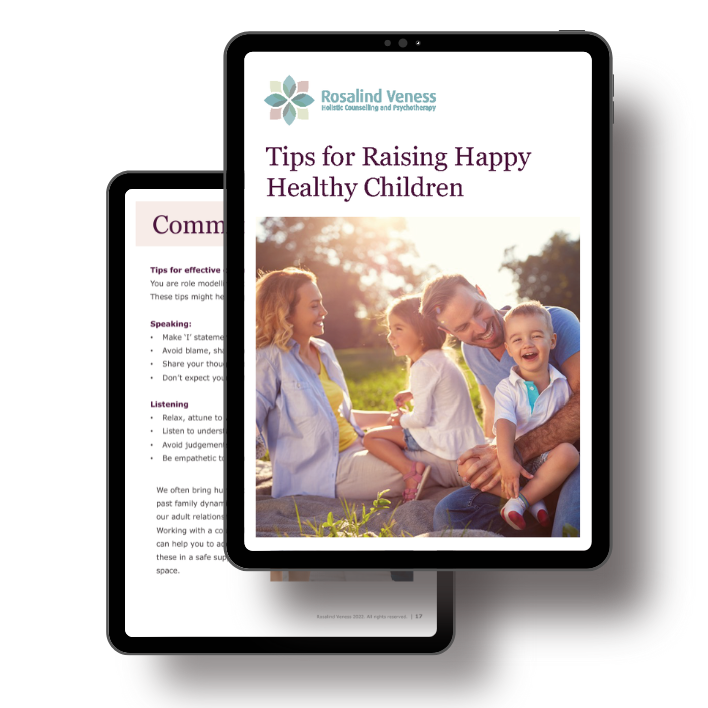
Tips for Raising Happy healthy Children
If you are concerned about your children’s behaviour, and feeling lost, then this might help. Download our FREE e-book Tips for Raising Happy, Healthy Children
Related Articles
References
- Perry, B.
- Porges, S.