The Healing Benefits of Nature
Helping your child develop a relationship with the natural world can support focus, attention, learning and emotional wellbeing.
As a therapist I find it’s difficult to be fully present with my clients if I am not present within myself
Parenting is much the same. Its difficult to be present and supportive with our children when we are not feeling relaxed and supported ourselves.
Have you noticed how your child’s behaviour improves, they become more focussed and attentive when you are able to slow down and be fully present with them?
And of course, the reverse happens too – parenting becomes more challenging when you are feeling tense, stressed or overwhelmed?
Noticing your Stress Levels
It’s not always easy to notice when your stress levels are increasing. They creep up gradually, then before you know it, both you and your child are escalating and in a conflict situation.
When my stress levels are increasing, I find it is harder to focus and be fully present in the moment. Some things I notice:
- feeling tight, tense
- racing thoughts
- unable to settle, to switch off
Perhaps you’ve also noticed similar signs in yourself and /or your child?
When this happens, I know it’s time to step outside and reconnect with the natural world.
Slowing down and spending time outside, I notice:
- My breathing slows, becomes deeper
- Tension in my jaw releases naturally, and I often start to yawn
- Tightness drops from my shoulders
- My thoughts stop racing around in my head, and
- I can think more clearly
Then I know nature is doing its work. I can come back to my day feeling refreshed and ready to be present and supportive
Why Nature can Help us Slow Down
Why does this happen?
Connecting with the natural world invites us to slow down, open our senses, and notice what is around us.
Finding time to connect with each other in a calm space, away from the pressures of everyday life, can support closer family connections, too. Closer connection enhances feelings of safety, and can be healing for your child who struggles with focus and attention.
Research shows that spending time in nature can benefit us in many ways – mentally, emotionally and physically. These benefits include:
- Reduced stress,
- Improved wellbeing,
- Increased feelings of relaxation
- Reduced heart rate and blood pressure
- Improved thinking and learning
Perhaps you’ve noticed similar changes in your children when they’ve spent time playing and exploring outside?
Focus and Attention Improve when we Feel Calm
Have you noticed that your child’s ability to focus and pay attention improves when they’re feeling calmer.
Learning and behaviour are often easier when children feel safe and secure. When the body is more relaxed, there is more capacity to take in new information and engage with what’s happening around them.
Being out in nature can improve feelings of wellbeing
A relaxed nervous system is more open to learning and taking in new information.
 Why Children Need to Feel Safe to Learn
Nature and Children’s Attention
Parents often notice a reduction in children’s stress levels and hyperactivity when they are able to regularly spend time outdoors.
Things you might notice:
- Improved sleep and moods
- Reduced signs of anxiety and depression
- Improved learning and concentration
- Better friendships and social skills
- Improved emotional regulation
- Becoming calmer and more peaceful
- Increased happiness, joy and excitement
- Reduced occurrence of frustration, anger and emotional outbursts
You don’t need to spend hours outside – even just a short period of time spent outdoors can help everyone to slow down, breather move and reconnect.
Why Unstructured Outdoor Play Matters
Free play outdoors supports social and emotional wellbeing in children. It also give them the opportunity to learn more about themselves and the wider world
In short:
- Nature engages and soothes
- Not only are your children “observing” nature, but they are also immersing themselves in and becoming one with nature
- Burn up excess energy – running, jumping climbing – building motor coordination, muscle strength, balance
- Freedom of being in open spaces – without instructions or prescribed activity other than to have fun!
- Child-led, unstructured play and exploration – more than just physical activity from playing sports.
- Children learn and develop new social skills through free, unstructured outdoor play – conflict resolution, listening and communicating
- Creative thinking – working together, problem solving, developing and agreeing on rules of play
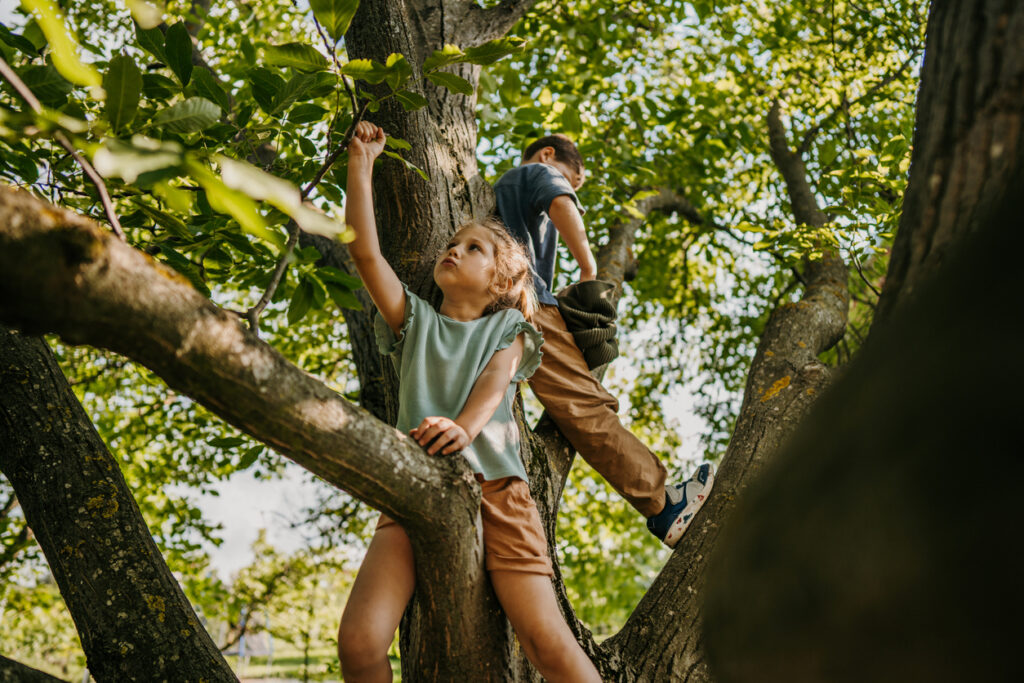
- Building resilience – climbing trees, dealing with minor cuts and scratches
Sensory Experiences
We take in information from our environment through our senses.
Helping your children to use their senses to become more open and aware of what is around them, will support their ability to focus, and therefore their learning ability.
Rather than simply observing nature, invite your child to become part of it, leaving their technology behind!
Something amazing can happen when we allow ourselves to become immersed in our natural surroundings.
We start to relax, to breathe more deeply
Being mindful of, and fully immersed in nature reminds us that as humans we evolved in nature, and are part of nature, not separate from it.
Providing opportunities for your child to explore their surrounding by using their senses can deepen relaxation benefits for both of you.
You can turn a walk into a simple sensory game. Ask your child to find:
- Five things you can see
- Four things you can touch
- Three things you can hear
- Two things you can smell
- One thing you can taste
Some things you might notice:
- Trees, flowers, grass, lizards and other small creatures
- Feeling of the breeze on your skin, the warmth of the sun on your face
- Texture of the bark on the trees
- Sounds of the waves at the beach, birdsong
- Scented leaves, flowers, the smell after rain
- Taste of salt spray on your lips at the beach
After a little while you might become aware that:
- your child’s breathing has slowed
- they’re feeling safer, more relaxed
- their thoughts are no longer racing,
- maybe they start to yawn
These are all signs that your body is beginning to relax, and that nature is doing its work.
Forest Bathing
This is a Japanese concept of mindful practice of spending time in the bush, simply being in the present moment. It was developed in the 1980’s and is now prescribed by Japanese doctors as a form of medical treatment.
Research has shown that forest bathing improves sleep quality, mood, ability to focus and stress levels
Leave your phone at home!
You don’t even have to walk if you don’t want to – you can just sit and open your senses to your surroundings
Take a few minutes to experience the sensations around you – sunlight through the trees, fungi on old fallen logs, mosses in damp areas, the scent of the bush…
Simple Ways to Bring more of the Natural World into Family Life
Time spent connecting with the natural world can help us all – not only our children.
Activities the who family can enjoy have the added benefit of building closer relationships through shared experiences.
Exploring
- Scavenger hunt. Make up a list of things to find when you’re out walking, perhaps things that begin with the letter B, or something for each colour of the rainbow
- Hike, walk, ride a bike
- Dig in the dirt. Find worms and bugs, and flip over rocks to see what’s hiding underneath
Getting Creative
- Make a nature table at home – shells, different shaped leaves, various bark textures, interesting rocks, feathers
- Leaf rubbings – collect interesting leaves and place them between two sheets of paper. Rub over the top with crayons, and watch the patterns emerge
- Build castles in the sand, make mud pies
- Gardening – let them put their hands in the dirt, learning about plants and growing things, nurturing small seedlings, watching them grow…
Moving and Playing
- Fly a kite on a windy day
- Green spaces – the zoo, local park, oval
- Jump in puddles after the rain
- Climb trees, clamber over rocks, balance on fallen logs
- Visit a playground – most children love to play on swings, slippery dips and climbing frames
Holidays
- Visit a farm – some farms offer farmstay holidays where children can connect with the animals and enjoy the sweeping open spaces
- Overnight camping – sitting around a campfire, watch the stars, listen to night noises
Finding Nature in Urban Areas
You don’t need to travel hours with your child to access the soothing benefits of green spaces. Nature is all around us, sometimes where we least expect to find it.
Maybe take a walk with your child around your local area.
- Observe peaceful gardens
- Touch the bark on the street trees
- Listen to the birds
- Stroll through a local park
- Pack a picnic and sit on the grass in the sunshine – even if it just your backyard
Invite your child to look out the window. What can they see?
- Clouds
- Tree tops
- Breeze
Bringing nature Inside your home
- Pot plants
- Balcony garden
- Open the windows, breathe in the fresh air
- Add rocks, crystals, flowers
- Sit quietly and imagine immersing yourself in a favourite spot in nature – what can you see, hear, touch, smell, taste?
Filling your own Emotional Cup
Parents need opportunities to slow down and reset too. If you find yourself struggling emotionally, feeling overwhelmed and exhausted, even micro-moments of nature-therapy can help:
- Looking out the window, noticing the clouds, the leaves on tress moving gently in the breeze
- Taking a deep breath and exhaling slowly
- Relaxing your jaw, dropping your shoulders
- Sometimes, simply stepping into the backyard for a few minutes can be enough to slow your breathing…
Some of my favourite nature spots for relaxation and stress release
Local river
- watch the sun sparkle on the ripples across the water,
- reflections of the clouds on a still day,
- hug a tree, touch the bark
- watch the seals gently floating in the water, or sunning themselves on the rocks
Botanic Gardens
- walk along bush tracks,
- notice your feet on the ground,
- stop and notice what is around you – what you can see, hear, smell, touch, feel, sounds …
- lie on the grass and watch the clouds float by,
- Watch the leaves above you move gently with the breeze
- Feel the sun on your skin
Beach
- feel your feet in the sand
- walk in the water
- stop, sit and listen to the waves
- watch the sunset
What Next?
When you notice your child’s focus and attention is waning, getting them outdoors in nature is a great opportunity to help them to de-stress.
When you notice your child’s focus and attention beginning to wane, perhaps instead of using a strategy to make them settle, the answer might be to take them outside!
Maybe they simply need space to move, breathe, play and reconnect – with you, with themselves and the natural world.
You don’t have to spend hours outdoors. Just a short break can help to refill everyone’s emotional cup, reduce tension, and improve ability to focus and pay attention.
Maybe go out for a walk together this weekend? Your children will probably love that you want to spend some time with them!
Read more:
When Parenting Feels Overwhelming – small ways to care for yourself
If this has resonated with you, and you would like to talk further, you’re welcome to get in touch.