Understanding Child Development, Learning and Behaviour
If your child is finding school difficult, you are not alone.
When your child started school, you were probably full of optimism, possibly expecting this to be the start of a great adventure.
Your child may have been excited about finally going to “big school”.
But for many families, things don’t always work out quite the way they expected.
Maybe your child took time to settle in, or perhaps they started refusing to attend, or were coming home crying and “losing it” at the end of the day?
Perhaps you’ve found yourself wondering why your child hasn’t settled in, asking questions like:
- “Why is my child struggling at school?”
- “Why can’t they keep up?”
- “Is there something wrong?”
- “Why is learning so hard?”
- “Is this ADHD, anxiety, or a learning difficulty?”
It can be confusing — especially when you know your child is bright, capable and trying their best.
If your child is struggling you’re not alone. Many parents find themselves asking the same questions.
Learning is More than just Trying Harder
Children who struggle in the classroom, are usually trying hard, and doing their best.
They want to learn and keep up with their classmates, but sometimes aspects of their development, sensory processing, emotional wellbeing or the demands of the classroom can make this much harder.
They may:
- Lose focus and concentration
- Become easily frustrated
- Struggle socially
- Meltdown emotionally
These behaviours can be confusing for parents, and difficult to understand. After all, your child seemed “ready” for school, excited and full of optimism.
Now you find yourself feeling confused, wondering what is happening, and how to help them.
 Is my Child Ready for School? Looking beyond reading and writing
What Might Your Child’s Behaviour Be Telling You?
It can be tempting to try and address the behaviour, or what we see on the surface – a child who is struggling to achieve to their potential.
What if there was another reason for your child’s struggles at school?
What if the behaviour was a clue, rather than a problem to be “fixed”?
When learning becomes difficult, children respond in different ways.
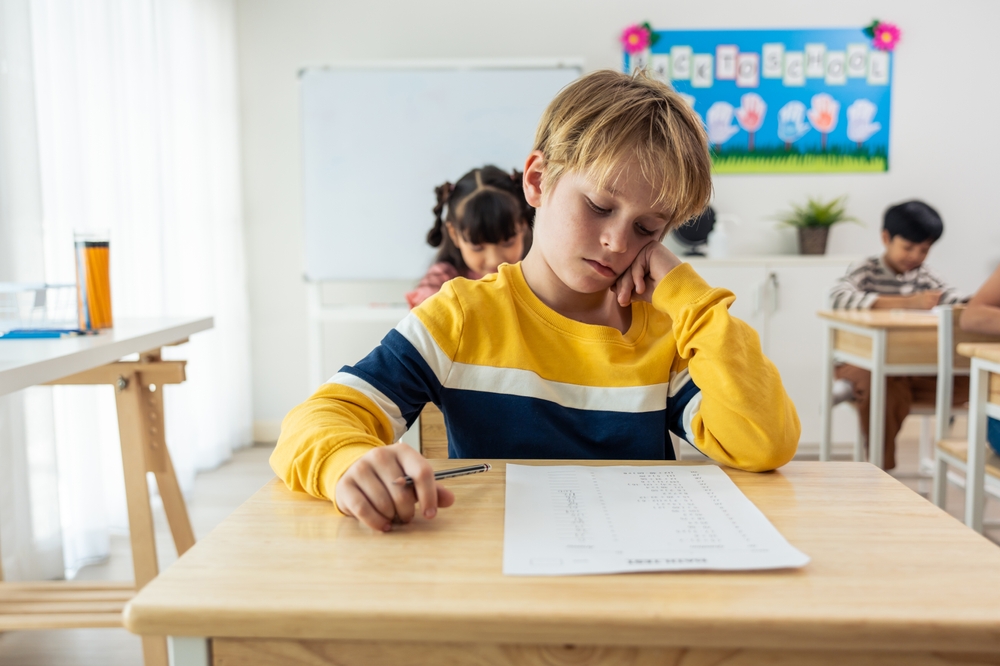
Some become restless or distracted, talking to their neighbours as they struggle to focus. Others might withdraw, perhaps gazing out the window, losing track of what the teacher might be saying.
You may see:
- Frustration or anger
- Fidgeting and constant movement
- Difficulty concentrating
- Sensitivity to noise or other sensory experiences
- Emotional outbursts
- Refusal to attend school
- Meltdowns and tension after school
- Loss of confidence.
Your child may look like they are misbehaving, but their behaviour may actually be telling us a different story.
These behaviours can be clues that there is more to understand about your child’s experience at school.
The answer may not lie in more tutoring, more intense effort, or behavioural plans or academic programs. Such approaches may only address what we see on the surface.
What if, instead of asking:
- “How do we stop this behaviour?”
We could also ask:
- “What is making learning so difficult for this child?”
Looking Beneath Your Child’s Classroom Struggles
Sometimes the answer may lie in early sensory and motor development, which builds pathways in the nervous system that is the foundation for all later learning – the ability to take in and process information coming from the environment.
Learning not just for tomorrow in the classroom, but for life.
When developmental foundations are incomplete or immature, some children may experience difficulties with things such as:
- Underachievement
- Behavioural problems
- Posture and balance
- Clumsiness
- Coordination
- Easily distracted
- Visual-motor skills
- Attention and focus
- Reading and writing.
Success in the classroom is built on strong foundations in a number of areas:
- Physical – coordination, movement, posture, sitting still
- Emotional – regulation, focus, concentration
- Academic – reading, writing, spelling
- Social – friendships
- Sensory – balance, listening, vision
Taking an holistic view – all these aspects need to work together to support your child’s learning, whether in the classroom or elsewhere.
One important aspect we can look at is retention of primitive reflexes and how they affect your child’s nervous system and feelings of safety.
Primitive reflexes are automatic movements present during infancy that normally become integrated as a child’s nervous system matures.
As a Developmental Practitioner I have spent over 20 years researching learning and child behaviour, exploring what might lie beneath the surface to understand what might really be happening for a particular child.
For some children, exploring these underlying developmental factors may provide another piece of the puzzle and help us understand why particular aspects of learning or classroom participation are difficult.
How Early Development Shapes Learning – the role of retained primitive reflexes
The Foundations for Learning
Learning doesn’t begin when your child starts school.
The foundations for learning started long before your child first walked through the school gates.
Even before birth, their early sensory perceptions were developing – your child was tuning in to your voice, your emotions, and your movements.
After birth their learning continued, deepening the connection with you as their safe place.
Throughout infancy and early childhood, the foundations for learning were being built through natural activities such as floor play, tummy time, free play and time spent with caring, nurturing adults.
Although it may not have seemed like it at the time, your child was gradually preparing their brain and nervous system for lifelong learning.
They were building the foundations to be able to:
- Sit still and maintain balance
- Maintain an upright position
- Process visual information
- Listen to understand
- Coordinate hand and eye movements
- Understand and regulate emotions
- Feeling safe and connected.
All these skills are necessary for successful classroom learning.
When some of these foundations are still developing, everyday demands of being in a classroom can be really hard for your child to understand and process.
Sometimes what appears on the surface to be a problem with attention, behaviour, reading or writing may have other underlying developmental factors that are worth exploring.
Building the Foundations for Learning
Learning Is More Than Just Reading and Writing
While schools tend to focus on academic skills, there is much more to learning than we might realise.
Children also need to feel safe in the classroom. While adults and carers may feel the classroom is a safe place, a child’s nervous system can be giving them a very different message.
When we feel safe we are more open to learning. When we feel threatened, our nervous system is more focussed on survival, preparing to run or fight the perceived threat.
For some children, a classroom can feel overwhelming, with lots of noise and visual distractions. Add to this social demands, pressure to “behave”, and complete their work, and many struggle to cope.
A child who is feeling tense or threatened, will find learning difficult. Their body will naturally focus on survival, often making it harder to understand what the teacher is saying.
When we understand the whole child, we can begin to consider what might be making learning difficult for them, and the best way to help them.
Over the past 20 years I have been working with children experiencing learning and developmental challenges, using movement-based approaches to build the early foundations for learning.
I found that the most important part of a child’s healing happened in relationship. As soon as they felt safe, seen and understood, their behaviour started to change.
When children feel safe, they are more open to learning in all its forms – social, emotional, behavioural, physical and academic.
Why Children Need to Feel Safe to Learn
Looking Beyond the Label
Teachers may suggest a diagnosis – perhaps suggesting your child might have ADHD, dyslexia or other learning difficulties.
While a diagnosis can offer understanding it doesn’t always give a complete picture of your child as a whole.
It can be easy to focus on your child’s challenges, and lose sight of their gifts, the things they enjoy, what lights them up and what brings you joy.
An holistic approach to healing starts with understanding your child’s struggle – taking in the whole child – as a unique and gifted individual.
Looking Beyond a Diagnosis – When Your Child is Struggling at School
It’s Never Too Late
If your child is struggling at school, there may be more to consider than first meets the eye.
This is an invitation to become curious – to look beneath the surface, asking:
- “What might be beneath the surface of what I am seeing in my child?”
- “What might be contributing to their struggles at school?”
These questions can open up a different way of understanding your child’s learning and behaviour challenges.
Children grow and develop at their own pace. This cannot be rushed, and there is little value in comparing children who are at different stages of development.
What Next
As a Developmental Practitioner I have spent the last 20 years researching and working with children who were struggling in the classroom, not only with academic learning, but also friendships and socialising, emotional regulation, and physical activities.
I now work primarily with parents, offering a warm, supportive space to explore your concerns, helping you to understand your child’s individual needs and create the changes you are looking for.
You’re welcome to reach out if you are concerned, or would just like to talk to someone who understands.
Often, the best way to help our children is to start with ourselves.
Helpful Articles
If you’re looking for answers about your child’s learning or behaviour, you may also find these articles helpful:
Supporting Your Child with Reading Difficulties and Dyslexia